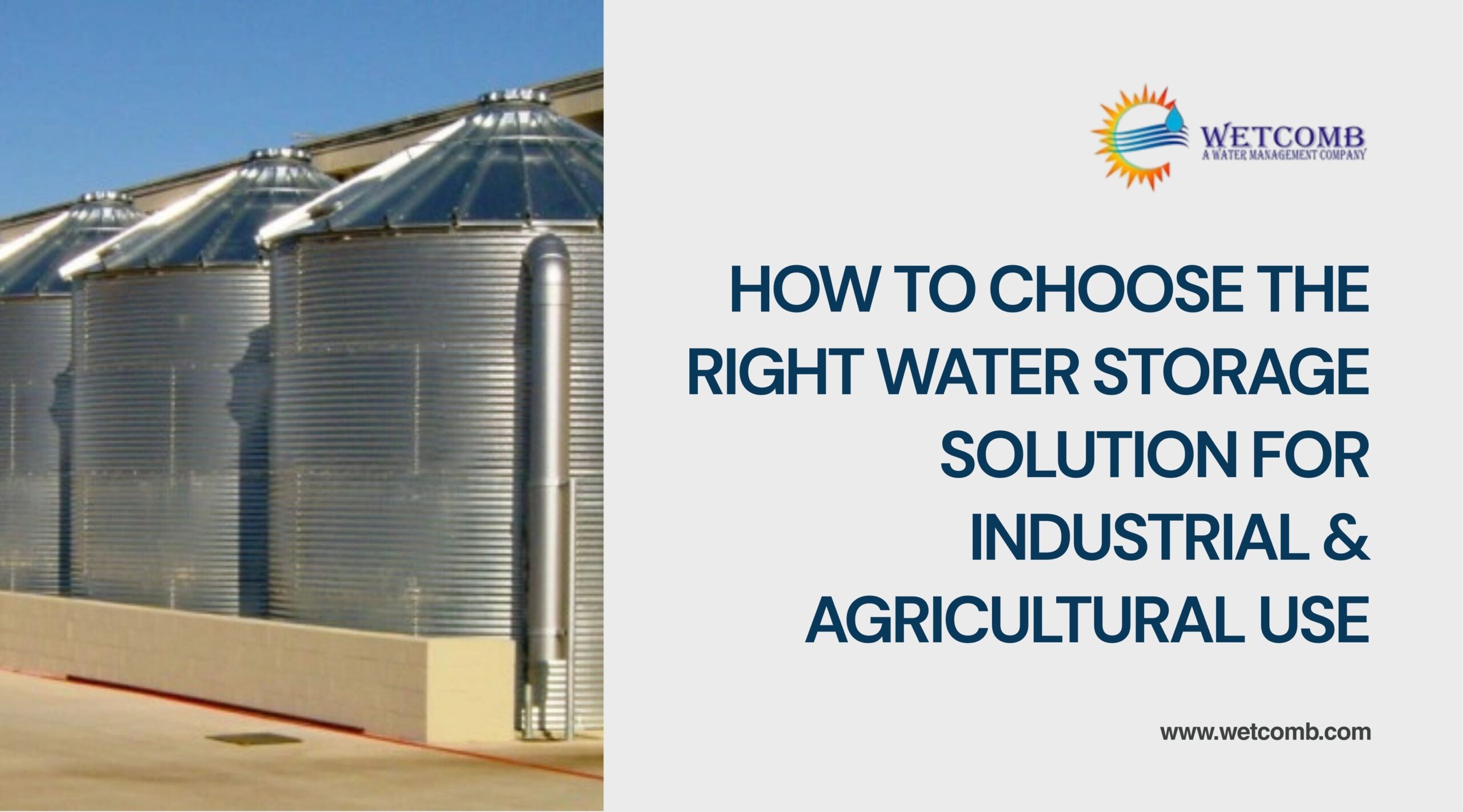
How to Choose the Right Water Storage Solution for Industrial & Agricultural Use
Water is the basic requirement for any industrial operation or agricultural process. Potable water storage tanks are essential no matter what you do, whether you work in a processing plant or handle multiple operations. Both farmers and industrial operators depend upon it for survival and prosperity.
For every factory operation and farming procedures, water is the most basic requirement. Both farmers and industrial operators depend upon it for survival and prosperity.
But here’s the challenge. One wrong decision can lead to contamination, structural breakdowns, unnecessary expenses and operating disruptions which cost you time and money. This guide will help you figure out how to choose among all the water storage solutions for what best suits your needs.
Why Water Storage Matters More Than You Think
A sufficient amount of water supply in industrial and agricultural areas is not enough in itself. The quality, as well as, timelines of such supply are also equally important.
In the growing seasons, water is considered as an essential requirement for farming and other related activities. Just one day without enough water in a heatwave can wipe out the entire crop. On the other hand, for cooling systems, processing, cleaning, and production tasks, a steady water supply is a must; otherwise, it will shut down the entire operation.
Water quality is also equally important. Contaminated water will damage the industrial equipment as well as destroy agricultural yields. It will violate health standards to a great extent. Moreover, water storage solutions directly affect water quality through its material choice, tank shape, and requirements for maintenance.
Understanding Your Water Storage Needs
Before choosing storage options, you must understand what you need to store and why.
Amount of Water Consumed: The water consumption can be easily estimated on daily, monthly and yearly basis. In the agricultural field, the use of water is maximum during planting and growing seasons, while manufacturing industries maintain a steady demand or proceed in sync with the market schedule.
Water Source and Quality: All water sources, whether collected rainwater, municipal supply, well water, or purified water, require their own relevant storage solution for better performance.
Usage of Water: Drinking water requires a higher quality than others, calling for a drinkable water tank with higher sanitary requirements. However, refills and cooling in industry do not need such strict measures.
Space and location: How much room do you have? Can you get materials and maintain the installation site? When choosing a location, there are factors of soil conditions and weather to consider too. Those practical considerations greatly limit your available choices.
Regulatory Requirements: What are the local laws, industry standards, or safety prescriptions applying to your operation? For example, a kitchen uses stricter water storage rules than those found on a construction site or in a factory.
Common Water Storage Mistakes to Avoid
Many businesses learn these lessons the hard way. Here are critical water storage mistakes that can cost you dearly:
Undersizing Your Storage Capacity: Many operations calculate their average daily needs but forget about peak demand times, emergency reserve or future growth. Running out of water at critical moments can be catastrophic.
Ignoring Water Quality Standards: The use of industry-specific tanks for drinking water or food processing is considered illegal by the government as it will endanger lives. Your tank material and certification must be according to the water usage.
Neglecting Maintenance: Every storage system needs regular cleaning, inspection, and maintenance. Ignoring this will lead to contamination, tank structural failure and shortening tank life.
Site Selection: If you place the water harvesting tanks on unstable ground in low-lying areas subjected to flooding, or somewhere where there is no access for either filling or maintenance, then you will have to face multiple future problems.
Skimping on Quality: Although buying the cheapest option may allow you to save money in the short run, it frequently leads to higher costs upfront in terms of more frequent replacements and operational stoppages because of contamination issues.
Inadequate Overflow and Drainage: Without proper overflow systems, tanks will be damaged wasting considerable amounts of water. Poor drainage can cause ponding water, mosquito breeding points and structural problems.
Forgetting about Cleaning Access: Tanks require cleaning at regular intervals. But without appropriate access points, the cost becomes more justified or practically prohibitive.
Key Features to Look For
When you look at water storage tanks in India and around the world, these features distinguish a fine product from one with problems:
UV Stabilization: For above-ground plastic tanks, UV stabilization keeps them from degrading under the sun. It also greatly extends their lifespan.
Certified Food-Grade: Food-grade certification is non-negotiable, as there must be no chance where water will come into contact with contaminants and be consumed by humans or livestock.
Proper Venting: It is really necessary to vent tanks properly. If not, a vacuum of extremely high level would be created inside the tank, and as a result, thermal expansion would not have been able to give a nice outcome.
Secure Covers: Covers prevent foreign contaminants like leaves, bugs and birds from entering, thus facilitating essential air exchange.
Level Indicators: It is very handy to know the water level in order to avoid sudden overflow, as well as to consider the better time for refilling.
Easy Drainage: Tank drain points which are oriented downwards, allow easy cleaning as well as the emptying of the entire contents when it is necessary.
Modular Expandability: Some systems allow you to build only as much capacity as you currently need. Therefore, it saves future construction costs.
Installation and Maintenance Considerations
The best tank but poorly installed creates headaches. Here is what to consider:
Foundation Requirements: Each tank has its own specific foundation needs. Plastic tanks require level and compacted surfaces, while concrete tanks require engineered foundations. Higher risk of settling, cracking or collapse are the costs behind improper preparation.
Accessibility: Ensure trucks can reach the site when necessary as well as operations vehicles can reach tanks for cleaning and repairs.
Plumbing Integration: Careful planning must be given to inlet, outlet, overflow and drainage systems otherwise it will create maintenance headaches.
Regular Inspection: Establish a system of quarterly visual inspections and yearly detailed evaluations. This will eventually discover small issues early and prevent future problems.
Cleaning Protocol: Each different type of source has its own optimum cleaning time and method. It is often best to clean agricultural tanks annually, while a water source will need constant attention in order to meet both the quantity and quality of drinking water requirements.
Making the Final Decision
With all this information, how do you actually choose?
Start by listing your non-negotiables : required capacity, water quality requirements, regulatory needs and budget limits. This immediately knocks out unsuitable options.
Select other remaining options, based on total cost of ownership not mere purchase price. Include installation costs in your calculations, while considering ongoing maintenance requirements, expected life span and environmental future replacement cycle.
Future flexibility: Will your needs change? Can the solution be adapted or expanded?
Finally, do not underestimate the value of working with experienced suppliers who understand industrial and agricultural water storage needs. They can help you avoid expensive mistakes and recommend the best possible solutions.
Finding the Right Partner
Choosing a water storage option is not just about deciding upon a tank, it is about finding a way of storing water that will reliably serve your operation for years to come. The right storage system becomes invisible infra-structure you never have to think about. The wrong one causes perpetual headaches.
Wetcomb specializes in providing the most appropriate water storage solutions like potable water tanks, rainwater harvesting tank, etc. for industrial and agricultural facilities in India. From understanding your specific requirements to recommending the most cost-effective and reliable solutions, we make sure that your water storage solution works as hard as you do. A solid water supply system will improve some aspects of your business so let us help you make that happen.