How Geo Lining Prevents Leakage and Groundwater Contamination
Water is one of our most precious resources. But each day thousands of litres of stored water leaks into the ground, thereby getting wasted and contaminated. It doesn’t matter if it’s a farm pond, an industrial storage unit or a municipal reservoir, leakage is always expensive, damages the environment and serves as a threat for the entire community.
The good news? Geo lining is a simple, proven, and affordable technology, serving as the most suitable option for creating the best geo tanks for water storage.
What Is Geo Lining?
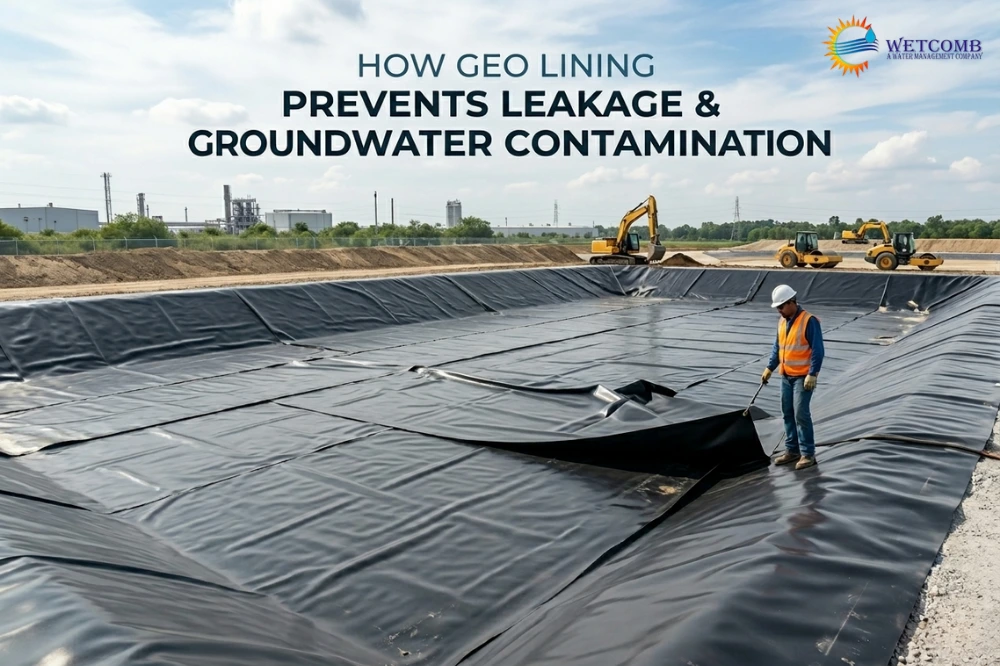
Think of geo lining as a thick, waterproof blanket placed inside or around a storage structure. It is a synthetic liner, made up of high-grade plastic materials, used to create a strong, sealed barrier between stored water or liquid waste and the surrounding soil.
When water is stored in an unlined tank or pond, it slowly seeps through the soil. This seepage does two harmful things:
- It wastes the stored water
- It carries chemicals or waste deep into the ground, where it mixes with underground water sources called aquifers
Geo lining puts a complete stop to both of these problems.
How Does Geo Lining Stop Leakage?
The most basic function of a geo liner is straightforward, it does not let water pass through.
Storage structures made up of concrete or compacted soil, also known as Traditional storage structures, can easily develop cracks over time due to excessive heat, cold, and rain. A geo liner works differently:
- Flexible Design — It can be stretched a little without breaking and bends with the shape of the ground without tearing.
- Crack-resistant — It does not expand or shrink due to change in temperature.
- Sealed at every joint — Once correctly installed, water has no way to escape
Geo Lined Tanks in India are now widely used across farms, construction sites, municipalities, and industries because of this reliable, leak-proof quality.
Why Is Groundwater Contamination a Serious Risk?
In rural India, groundwater provides drinking water to millions of people. If a storage site has leaked, the liquid will penetrate down through layers of soil. If it consists of chemicals, industrial waste, pesticides, or sewage, the water becomes unsuitable for drinking and other farming purposes.
The risks are significant:
- Once contaminated, groundwater can take years or even decades to recover.
- All those communities who mainly depend upon wells and borewells will get affected.
- Nearby agricultural land becomes unfit for cultivation.
- Industries can face heavy legal and environmental penalties.
Hence leakage prevention not only helps in saving water but also contributes a lot in protecting the health of entire communities.
How HDPE Geo Lining Helps Prevent Contamination?
High Density Polyethylene, abbreviated as HDPE, is another reliable material used in geo liners. HDPE geo lining has become one of the most popular material because of the following properties:
- Resistant to chemicals – non-reactive to acids, oils, salts or industrial waste
- Near-zero permeability: No liquid can get through it
- UV resistant — Tough against extreme sun exposure
- Long lifespan — performs reliably for 20 to 30 years with low maintenance
Geo-Membrane Tanks in India using HDPE liners are now considered as a standard solution across mining, wastewater treatment, agriculture, and chemical storage, working tirelessly in order to protect soil and groundwater without constant attention.
Where Is Geo Lining Used?
The use of Geo lining is not limited to just one single kind of project. It can be used for a number of applications like:
- Farm Ponds and Irrigation Tanks — Reduces the amount of water lost through seepage, allowing better water storage
- Industrial Waste Pits — Prevents the entry of toxic liquid into the soil
- Landfills — Stops leachate (the toxic liquid from decomposing waste) from reaching groundwater
- Municipal Water Reservoirs — Keeps stored drinking water clean and uncontaminated
- Construction Sites — Controls runoff and prevents soil pollution
In every one of these cases, the geo liner acts as a silent, round-the-clock protector.
Is Geo Lining Affordable?
Many people think that geo lining is expensive. But when compared to the cost of doing nothing, it is one of the smartest investments in water management. Affordable geo lining solutions are available for both small and large projects in India, from farm ponds to industrial reservoirs for many industries.
Think about what happens in the absence of a proper lining:
- Increased refilling costs due to continuous water loss
- Soil and groundwater damage leads to expensive cleanup
- Regulatory penalties for environmental violations
- Structural damage to storage sites over time
Geomembrane lining services offer completely customised solutions as per the size of the area, the type of liquid stored, and local soil and climate conditions, so you don’t have to pay anything extra.
Selecting the Ideal Geo Liner – Quality Matters
Not all geo liners have the same performance. Here is what to look for while choosing one:
- Type of Material — always use certified HDPE or LLDPE liners
- Thickness — aligned to the volume and type of liquid stored
- Seam quality — every seam has to be welded properly and pressure tested
- UV & puncture resistance — a mandatory quality for outdoor, long-term installations
These high quality geomembrane liners are also tested for tensile strength, chemical resistance, and durability under extreme weather to ensure that they are suitable for use. A poor-quality liner may develop micro-tears or weak seams within a few years, which completely defeats the purpose. Always insist on quality certification and professional installation.
Conclusion
Geo lining is one of the most basic yet effective tools used for preventing water leakage and groundwater contamination. It provides a tangible, impenetrable seal to ensure that the stored liquids stay inside the structure, and not in the soil below.
At Wetcomb, we specialize in crafting high-performance geo lining solutions that are ideal for Indian conditions. Our team will handle everything from site evaluation to installation and after-sales maintenance to provide leak-free and contamination-proof storage structures.